Reliability Study — Failure Modes of Composite Cables
Case study · reliability & accelerated-life modeling
Résumé
Composite cables deployed onshore and offshore experience different combinations of mechanical, thermal and environmental loading, and can fail through several distinct mechanisms — fiber/matrix debonding, delamination, fretting, micro-buckling, hydrothermal aging and termination corrosion. This case study documents a reliability study that classified these failure modes through root-cause and fractographic analysis, quantified their life distributions and temperature acceleration through Weibull and Arrhenius modeling of accelerated aging data, and prioritized design and maintenance actions with a formal FMEA scoring process.
Introduction & objectifs
A cable qualified for one deployment environment is not automatically safe in another: offshore service adds salt-fog and immersion exposure to the onshore mechanical and thermal duty cycle, and each additional stressor can activate a different dominant failure mechanism. Rather than qualify by exhaustive real-time testing in every environment, the project combined physical failure analysis with statistical life modeling to extrapolate confidently from accelerated laboratory data to field conditions, targeting three objectives:
- Failure-mode classification — identify and physically confirm, via fractography and microscopy, the distinct mechanisms by which the cable can fail under each operating envelope.
- Quantitative life modeling — fit statistical life distributions to accelerated aging data and extrapolate to field-use conditions with a defensible acceleration factor.
- Risk-prioritized action — rank failure modes by a formal FMEA scoring process and translate the highest-risk items into concrete design updates and inspection intervals.
Cadre théorique
Weibull life distribution
Time-to-failure data from each test condition was modeled with the two-parameter Weibull distribution, whose reliability (survival) function is:
with shape parameter β (indicating whether the failure rate is decreasing, constant or increasing with age) and scale parameter η (the characteristic life, at which R = e−1 ≈ 36.8 %). The corresponding instantaneous failure rate (hazard function) is:
Parameters were estimated from failure-time data by linearizing the distribution — taking the double logarithm of the reliability function turns it into a straight line whose slope is β and intercept locates η:
and the resulting mean time to failure follows from the Weibull distribution’s known first moment, using the gamma function Γ:
Accelerated aging & the Arrhenius life-stress model
Because waiting out the cable’s real-time field life in the laboratory is impractical, life was measured at several elevated temperatures and extrapolated to the field-use temperature using the Arrhenius life-stress relation,
where Ea is the failure mechanism’s activation energy and k is Boltzmann’s constant. Comparing life at the use temperature Tuse to life at an accelerated test temperature Ttest gives the acceleration factor used to convert a short, hot test into a field-life estimate:
Fitting Equation (1) separately at each test temperature, then fitting Equation (5) across temperatures using each condition’s characteristic life η, gave both the shape of the failure-time distribution and its temperature sensitivity from a practically sized test matrix.
FMEA risk quantification
Each identified failure mode was scored on three 1–10 scales — severity S, occurrence O and detectability D — and combined into a Risk Priority Number used to rank remediation priority:
with design and inspection resources directed first at failure modes combining high severity with either high occurrence or poor detectability, rather than at the highest raw RPN in isolation.
Méthodologie
Failure-mode identification
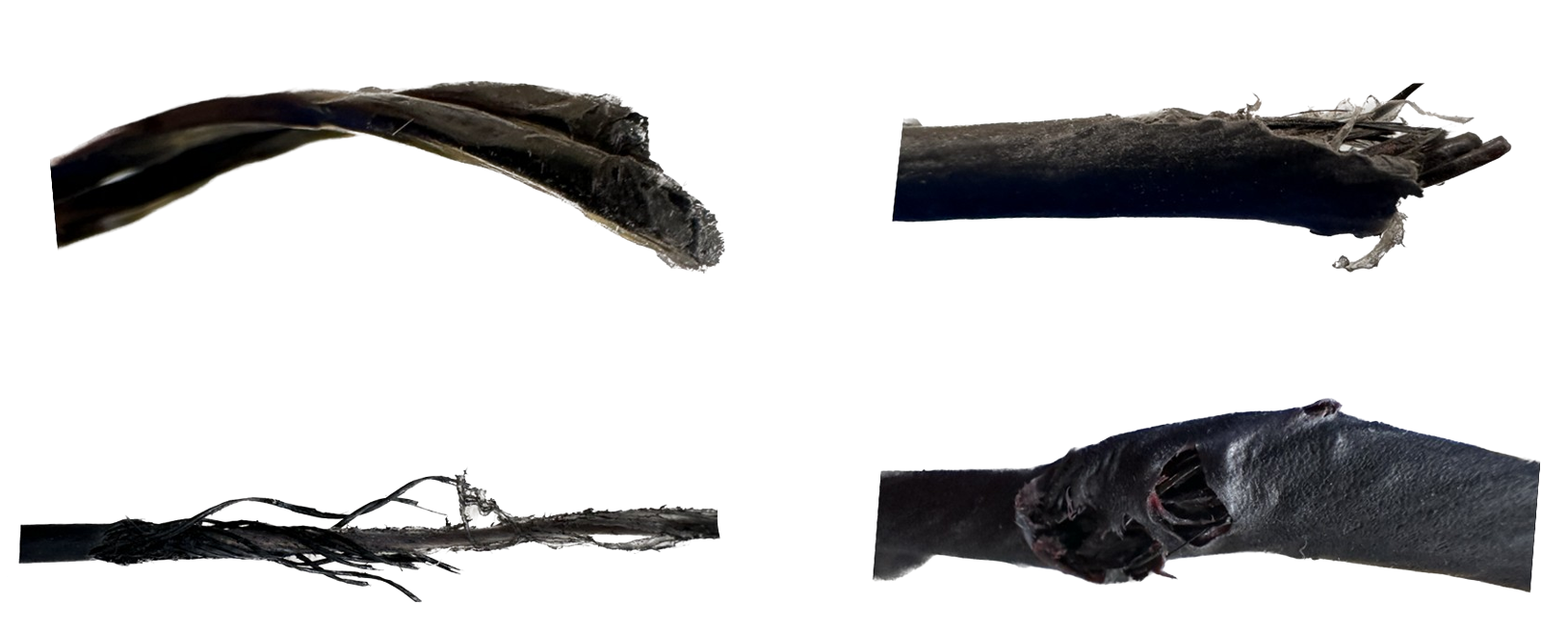
Fractography and microscopy on cables removed from onshore and offshore service, together with dedicated bench tests, were used to root-cause each observed failure into one of six mechanisms: fiber/matrix debonding, delamination, fretting at layer interfaces, micro-buckling under compressive loading, hydrothermal aging of the matrix, and corrosion at metallic terminations. Each mechanism was then mapped to the operating envelope (tension, bending, torsion, temperature, humidity/salt fog) that activates it most strongly.
Reliability methods
For each dominant failure mode, specimens were run to failure at several accelerated temperatures under representative load spectra. Failure times at each temperature were fit to the Weibull model of Equations (1)–(3) to obtain shape and characteristic-life parameters, and the resulting characteristic lives were fit across temperature to the Arrhenius relation of Equation (5) to obtain an activation energy and, from it, the acceleration factor to the actual field-use temperature. Every failure mode identified in Section 3.1 was additionally scored for severity, occurrence and detectability and prioritized by the RPN of Equation (6).
Recommendations
High-RPN failure modes drove specific design updates (layup or termination geometry changes, material substitutions, protective coatings) targeted at reducing either occurrence or severity. For failure modes that could not be fully designed out, a predictive-maintenance inspection interval tinsp was derived directly from the fitted Weibull model by solving Equation (1) for the time at which reliability first drops to a minimum acceptable level Rmin:
giving a physically grounded inspection schedule for onshore versus offshore use instead of a single generic interval applied uniformly to both.
Résultats & retombées
Fractographic root-causing confirmed distinct dominant failure modes for onshore versus offshore service, with hydrothermal aging and termination corrosion weighted more heavily offshore. Weibull fits (Equations 1–3) characterized each mode’s failure-time scatter, and the Arrhenius fit of Equation (5) yielded an activation energy and acceleration factor that let short, elevated-temperature tests stand in for multi-year field exposure with a stated confidence level. FMEA prioritization via Equation (6) focused design changes on the highest-risk failure modes, and the inspection interval of Equation (7) gave differentiated, reliability-target-based maintenance schedules for onshore and offshore deployments.
Environnement technique
Failure-mode analysis followed FMEA / DFMEA frameworks and standard reliability statistics (Weibull, Arrhenius). Accelerated life data was generated on environmental and mechanical test benches (salt-spray, thermal cycling, bending/tension), and failure confirmation used fractography and microscopy.
Nomenclature
| Symbole | Signification |
|---|---|
| R(t), λ(t) | Weibull reliability function and hazard rate |
| β, η | Weibull shape and scale (characteristic life) parameters |
| MTTF, Γ | Mean time to failure and the gamma function |
| L(T), A, Ea, k | Arrhenius life, pre-exponential factor, activation energy, Boltzmann constant |
| AF, Tuse, Ttest | Acceleration factor and use / test temperatures |
| S, O, D, RPN | FMEA severity, occurrence, detectability and risk priority number |
| tinsp, Rmin | Recommended inspection interval and minimum acceptable reliability |
Références
- W. Weibull, “A Statistical Distribution Function of Wide Applicability,” Journal of Applied Mechanics, 1951.
- S. Arrhenius, “On the Reaction Velocity of the Inversion of Cane Sugar by Acids,” 1889.
- US DoD, MIL-STD-1629A — Procedures for Performing a Failure Mode, Effects and Criticality Analysis, 1980.
- ASTM D3045, Standard Practice for Heat Aging of Plastics Without Load, ASTM International.
- R. B. Abernethy, The New Weibull Handbook, 5th ed., 2006.